Market level changes reach the plant floor through a small number of mechanisms. This report traces them and sets out what they mean for an equipment decision.
Total cost of ownership over ten years
Purchase price is typically 25 to 35 percent of the ten-year cost of a batching plant. Energy, labour, maintenance, wear parts and downtime make up the remainder. A plant that costs 15 percent more at purchase and 20 percent less to run is the cheaper machine.
Downtime is the hardest item to quantify and often the largest. One day of lost production on a 60 m3/h plant can exceed the annual saving from choosing a cheaper component supplier.
Cost element
Typical share of 10-year cost
Purchase and installation
25 - 35%
Energy
15 - 20%
Labour
15 - 20%
Maintenance and wear parts
10 - 15%
Downtime and lost output
10 - 20%
Equipment in extreme climates
Heat, cold, dust and humidity each change the specification. In desert conditions the priorities are cooling capacity, air filtration and electrical enclosure protection. In cold climates they are heating, insulation and low-temperature lubricants and steels.
Coastal and tropical sites add corrosion to the list. A paint system and a galvanising specification chosen for a temperate inland site will fail within a few years on a coastal site, and the repair cost exceeds the original saving.
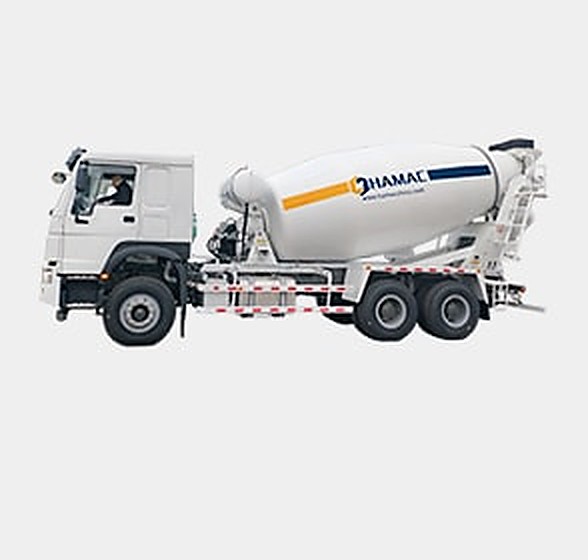
Concrete mixer truck discharging ready-mix concrete — HAMAC equipment supplied to concrete and aggregate projects worldwide.
The infrastructure pipeline and equipment demand
Large infrastructure programmes create demand in waves. Earthworks and crushing come first, then concrete production for structures, then paving and finishing. Equipment suppliers who understand the sequence can plan production and stock accordingly.
For buyers, the same sequence is a warning about timing. Ordering a batching plant when the programme reaches the concrete phase often means joining a queue, and lead times extend exactly when the project needs the plant most.
Skills shortage and equipment design
A shortage of experienced operators and technicians is reported in most markets. Equipment design responds in two ways: simpler interfaces that reduce training time, and diagnostics that tell a technician what to check rather than requiring him to interpret symptoms.
Suppliers who provide structured training and clear documentation reduce the operational risk for a buyer. In a market where experienced staff are scarce, that support is a genuine part of the product.
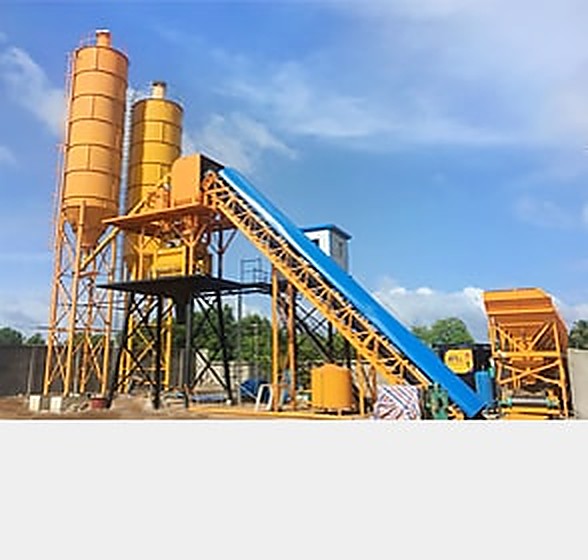
Stationary concrete batching plant with aggregate bins and cement silos — HAMAC equipment supplied to concrete and aggregate projects worldwide.
What buyers should watch in the next cycle
Three developments are worth tracking: the cost of cement and its effect on mix design, the availability of skilled operators, and the financing conditions for small and mid-size contractors. Each changes what kind of equipment sells, independently of the total construction volume.
A buyer who understands these drivers can time an order better and specify a machine that will still be appropriate when the market shifts. That is a more reliable advantage than negotiating the last few percent of the purchase price.
Where global demand is moving
Concrete equipment demand is shifting towards markets where infrastructure spending is rising and where local ready-mix capacity is still being built. That combination describes parts of Africa, South and Southeast Asia and the Middle East more accurately than it describes mature markets, where demand is mostly replacement and upgrade.
The consequence for buyers is that equipment availability and delivery time have become as important as price. A plant that arrives two months late costs more than a plant that costs slightly more and arrives on schedule.
Decarbonisation at the equipment level
Most of the carbon in concrete comes from cement, not from the plant. Equipment can still make a measurable difference: accurate batching avoids over-cementing, moisture compensation reduces water and cement variation, and efficient mixers shorten cycle time per cubic metre.
Electrification of plant drives and the use of variable-frequency controls reduce electricity consumption, and solar-ready control cabins are appearing on new installations in sunny markets. These measures are incremental, but they are also the ones a plant owner can act on without changing the mix design.
Where to go next
For the equipment side, see equipment solutions; for plant-level design and layout questions, see global project references. If the project is in Egypt or a comparable market, the HAMAC team can provide reference installations and a configuration proposal against your daily output target.
If you are comparing configurations, share the requirement with HAMAC and ask for a like-for-like quotation with the included scope listed item by item.
Need help applying this to your project?
Send your material type, target output and site conditions to HAMAC engineers. You will receive a practical equipment configuration and a clear quotation, normally within one working day.
Questions about this topic
How does automation affect operating cost?
Automation reduces labour per cubic metre and produces batch records that reduce rejected loads. The larger benefit is traceability for quality schemes.
How does climate change the equipment specification?
Hot climates need additional cooling and filtration; cold climates need heating, insulation and low-temperature materials; coastal sites need a higher corrosion specification.
What is the payback on a new batching plant?
It depends on utilisation and local concrete price. A plant running at high utilisation typically pays back in three to six years.
H
HAMAC Machinery Editorial Team
Written and reviewed by engineers and sales specialists who configure concrete batching plants, crushers, mixers and pumps for projects in more than 180 countries. Content is based on factory testing data and field feedback from delivered equipment.





 Company News