Buyers often compare a crushing plant on price before they compare it on duty. The sections below set out what the duty actually involves for a ready-mix company supplying high-rise work working with andesite aggregate, and where cost is really created. The reference case is a 144 t/h operation in Indonesia.
The operating context matters as much as the machine specification. In Indonesia, a ready-mix company supplying high-rise work works in tropical heat, humidity and frequent heavy rain. A plant specified for this market normally includes anti-corrosion treatment and electrical protection against moisture ingress, and the layout is planned around andesite aggregate rather than a generic aggregate.
Jaw crusher as the primary stage
A jaw crusher reduces large feed to a size a secondary crusher can accept. Its advantages are a large feed opening, tolerance of clay and slabby rock, and simple maintenance. The trade-off is a flaky product shape and a capacity that drops sharply when the feed is wet and sticky.
The closed side setting controls the product size but also the capacity. Reducing the setting to produce a finer product increases the number of passes and the wear on the plates. For most quarry plants the primary setting is chosen to feed the secondary stage efficiently rather than to make a saleable product directly.
Cone crusher for hard rock and shape
A cone crusher produces a cubical product at high reduction ratios and tolerates hard abrasive rock better than an impact crusher. Cavity selection matters more than headline power: a coarse cavity handles a larger feed but produces a flatter shape, while a medium or fine cavity improves shape at lower throughput.
Cone crushers are usually operated in closed circuit with a screen, returning oversize to the crusher. This is what allows a plant to hold a tight product specification without excessive fines generation. The circulating load is a normal part of the process, not a sign of a problem.
Material
Abrasion
Typical primary
Typical secondary
Granite, basalt
High
Jaw crusher
Cone crusher
Limestone
Low to medium
Jaw or impact crusher
Impact crusher
River gravel
Medium
Jaw crusher
Cone crusher
Construction waste
Medium
Jaw crusher
Impact crusher
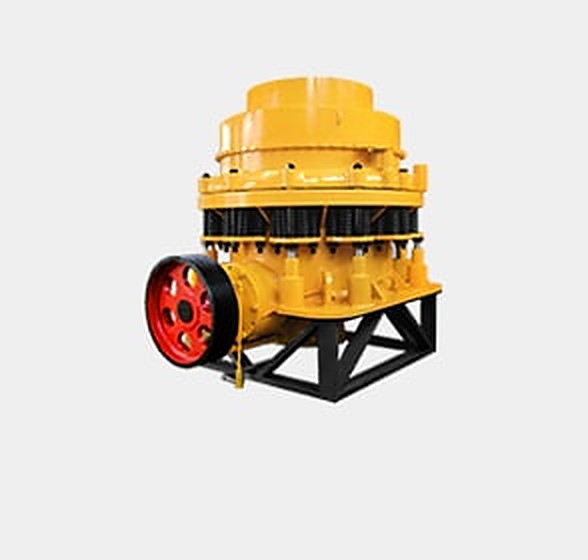
Spring cone crusher for secondary crushing of hard rock — HAMAC equipment supplied to concrete and aggregate projects worldwide.
Impact crusher for shape and soft rock
An impact crusher uses velocity rather than compression, which produces a well-shaped product with a high proportion of fractured faces. It is the preferred choice for limestone, dolomite and recycling, where the material is not highly abrasive.
Wear cost is the deciding factor. Blow bars in abrasive rock wear quickly, and the cost per tonne can be several times higher than a cone crusher on the same duty. On the right material, however, the shape advantage often justifies the wear cost because it reduces cement demand in concrete.
Plant layout and material flow
A crushing plant is a sequence of transfer points, and every transfer point is a source of dust, spillage and wear. Keeping chutes steep enough for the material to slide, using impact plates at load points and minimising the number of transfers all reduce maintenance.
Stockpile layout decides how efficiently the plant can operate. Finished products need separate stockpiles with enough capacity to allow the plant to run through a full shift and to load trucks without rehandling. Conveyors should be positioned so that stockpiles can be built without pushing material with a loader.
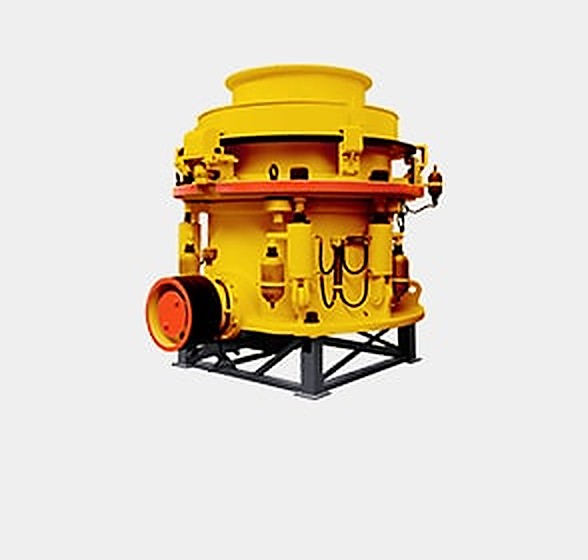
Multi-cylinder hydraulic cone crusher in an aggregate plant — HAMAC equipment supplied to concrete and aggregate projects worldwide.
Screening efficiency
Screen efficiency depends on bed depth, stroke, angle and mesh condition. Overloading a screen with a thick bed lets fine material ride over the mesh into the oversize, which then returns to the crusher and inflates the circulating load. Keeping the bed to a few particle layers is the single most effective improvement.
Mesh condition is often overlooked. Worn or broken wires change the effective aperture and let oversize into the product. Checking mesh tension weekly and replacing damaged panels promptly protects both product quality and the crusher behind the screen.
Dust control and enclosure
Dust is generated at the crusher discharge, at every conveyor transfer and at the screen. Enclosing the transfer points and fitting a water spray or fog system at the crusher inlet and discharge controls most of the visible dust. Water quantity must be controlled so that the product moisture stays within the limit the customer accepts.
In dry climates a bag filter on the crusher and screen enclosure is more effective than water alone, but it needs regular cleaning to remain efficient. A filter that is not maintained becomes a restriction and can pressurize the enclosure, pushing dust out through every gap.
Wear parts and maintenance planning
Jaw plates, cone mantles and bowls, blow bars and screen meshes are the consumables that drive the maintenance budget. Wear rate depends on abrasiveness, feed size and reduction ratio. Tracking wear against tonnes produced gives a reliable forecast for ordering and for budgeting.
Maintenance access should be designed into the plant. A crusher that requires dismantling a conveyor to change a mantle will lose more production than a slightly more expensive design with proper access platforms and a lifting beam.
Where to go next
For the equipment side, see crushing and screening plants; for plant-level design and layout questions, see aggregate production solutions. If the project is in Indonesia or a comparable market, the HAMAC team can provide reference installations and a configuration proposal against your daily output target.
Send the daily volume, mix types and site conditions to HAMAC engineers and you will receive a configuration and a quotation, normally within one working day.
Need help applying this to your project?
Send your material type, target output and site conditions to HAMAC engineers. You will receive a practical equipment configuration and a clear quotation, normally within one working day.
Questions about this topic
How do I reduce fines in my product?
Reduce the reduction ratio per stage, use a cavity matched to the feed, and avoid over-crushing in closed circuit. Screening before the crusher also removes material that does not need crushing.
How do I calculate the crusher size for 150 t/h of finished aggregate?
Work backwards from the product split, add the oversize returned from the screen, and divide by the available operating hours. Then confirm the primary can accept the largest feed lump at that rate.
Why is my cone crusher producing flaky aggregate?
The cavity is probably too coarse for the product size, or the feed is poorly graded. A finer cavity and a closed circuit with a screen usually correct the shape.
H
HAMAC Machinery Editorial Team
Written and reviewed by engineers and sales specialists who configure concrete batching plants, crushers, mixers and pumps for projects in more than 180 countries. Content is based on factory testing data and field feedback from delivered equipment.





 Company News