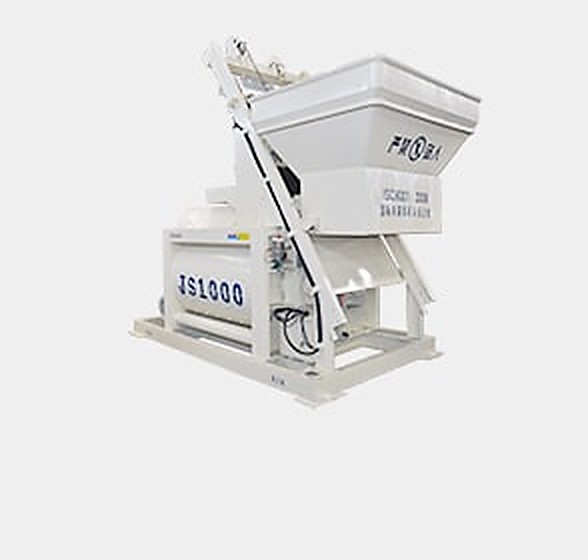
This guide sets out a concrete batching plant for a contractor on an industrial park working with crushed granite. It covers the decisions that change output and running cost, and the checks worth making before an order is placed. The reference case is a 50 m3/h operation in Uzbekistan.
The operating context matters as much as the machine specification. In Uzbekistan, a contractor on an industrial park works in cold winters and very hot, dry summers. A plant specified for this market normally includes heated water capability, insulated lines and a cooling package for summer operation, and the layout is planned around crushed granite rather than a generic aggregate.
Dust, noise and environmental control
Dust comes from three points: aggregate charging, cement filling and truck loading. Enclosing the batching machine and fitting a shaker or pulse-jet filter to the silo handles most of it. Water sprays at the charging hopper are effective but must not add uncontrolled water to the mix, so they are usually interlocked with the batching sequence.
Noise is dominated by the mixer, the air compressor and the aggregate feed. Rubber buffers under the mixer frame, a silenced compressor and a lined control cabin bring the working environment within normal industrial limits. Settlement ponds or a recycling unit deal with wash water from the mixer and truck chute.
Commissioning sequence
Commissioning begins with a mechanical check of every bolt, guard and limit switch, followed by a dry run of each motor in the correct direction. Weighing systems are then calibrated empty and with test weights before any material enters the plant.
The first production batches should be small and inspected for uniformity and slump. Only after three consecutive batches meet the specification should the plant move to normal output. Recording the actual cycle time during these first batches gives a realistic figure for planning deliveries.
Rated output
Typical realistic output
Usual application
HZS25 - 35 m3/h
20 - 28 m3/h
Small contractor, single site
HZS50 - 60 m3/h
40 - 50 m3/h
Commercial supply, small town
HZS75 - 90 m3/h
60 - 75 m3/h
Ready-mix supplier, mid-size city
HZS120 - 180 m3/h
95 - 145 m3/h
High-volume ready-mix, major projects
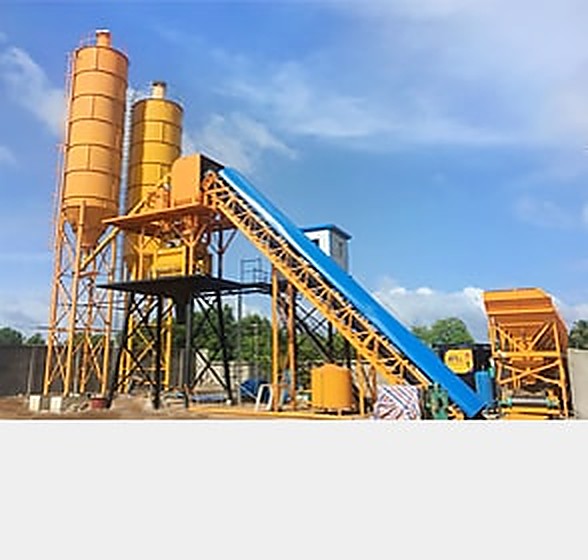
Stationary concrete batching plant with aggregate bins and cement silos — HAMAC equipment supplied to concrete and aggregate projects worldwide.
Maintenance rhythm that prevents stoppages
Daily checks cover the mixer blades and liners, the discharge gates, the air line pressure and the water supply. Weekly checks include belt tension, screw conveyor bearings and the condition of the weighing frame. Monthly work covers gearbox oil, filter cleaning and a full calibration verification.
Wear parts should be replaced on measurement, not on failure. Mixer blades worn beyond the manufacturer limit lengthen mixing time and leave material on the floor of the drum, which shows up as variation between batches long before a breakdown occurs.
Winter and hot-climate operation
In cold weather the constraint is heat loss rather than machine capability. Heated water, insulated pipes and a heated aggregate compartment allow production to continue, but mixing time must be extended and the water temperature kept below the value at which cement flashes. Fresh concrete must be protected between the plant and the formwork.
In hot climates the risks are rapid slump loss, high water demand and overheating of hydraulic systems. Chilled water or ice, shaded aggregate stockpiles and a mixing sequence that adds water at the end of the cycle all help. Control cabins need forced ventilation or air conditioning to protect both the operator and the electronics.
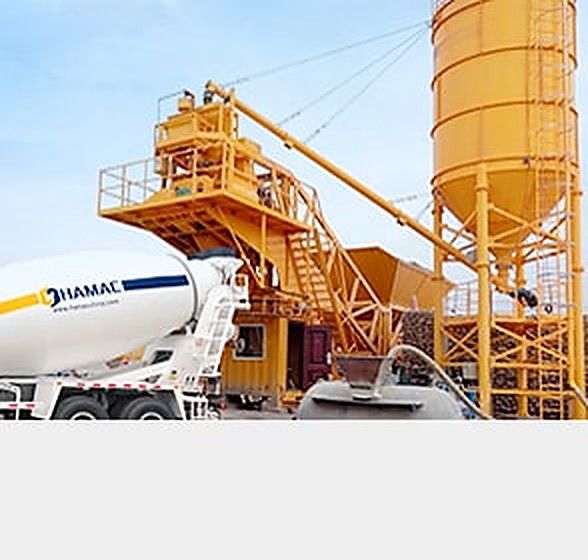
Mobile concrete batching plant mounted on a steel frame — HAMAC equipment supplied to concrete and aggregate projects worldwide.
Upgrading an existing plant
Most plants can gain output without replacement. Adding a second cement silo removes the waiting time between cement deliveries, enlarging the aggregate bins reduces loader cycles, and upgrading the control system shortens the batching sequence. A larger mixer is the most direct route but requires checking the structure and the discharge height.
Before any upgrade, measure the actual cycle time of the existing plant over a full shift. The result usually shows where the bottleneck is: charging, mixing, discharge or truck movement. Investment should follow that measurement rather than a general assumption that more equipment means more output.
What drives the purchase price
Two quotations for the same nominal capacity can differ by 30 percent or more. The difference usually sits in steel plate thickness, mixer gearbox and liners, load cell brand, control system, silo capacity and the scope of the delivery. A quotation that excludes silos, screw conveyors or the control cabin is not comparable with one that includes them.
The more useful comparison is cost per cubic metre over the life of the plant. A heavier structure with better wear parts costs more at the start and less every year afterwards, because it needs fewer repairs and holds calibration longer.
Common faults and their causes
Weight errors usually trace back to a drifting load cell, a gate that does not close fully or material stuck on the weighing frame. Slow discharge is normally a worn gate seal or a discharge height that forces the truck to reposition. Mixer noise points to bearing wear or a loose blade arm.
Electrical faults are frequently environmental: moisture in a junction box, dust on a contactor or a voltage drop on a long supply cable. A plant installed with a proper earthing system and a stabilized supply suffers far fewer of these interruptions.
Where to go next
For the equipment side, see concrete batching plants; for plant-level design and layout questions, see concrete production solutions. If the project is in Uzbekistan or a comparable market, the HAMAC team can provide reference installations and a configuration proposal against your daily output target.
HAMAC can prepare a layout drawing and a budgetary quotation against your daily output target, including the civils information your contractor will need.
Need help applying this to your project?
Send your material type, target output and site conditions to HAMAC engineers. You will receive a practical equipment configuration and a clear quotation, normally within one working day.
Questions about this topic
What size batching plant do I need for 200 m3 per day?
A 50 to 60 m3/h plant covers 200 m3 in a single extended shift with normal truck turnaround. If the work is concentrated into a short window, choose 75 to 90 m3/h so the plant is not the constraint.
Is a foundation required for a batching plant?
Yes for stationary plants. The foundation drawings are issued with the order and must be followed, because the batching machine, silo and mixer loads are concentrated. Mobile plants sit on compacted hardstanding.
Can the plant run on a generator?
Yes, but the generator must be sized for the starting current of the mixer and the conveyors, not for the running load. Undersized generators cause contactor chatter and control faults.
H
HAMAC Machinery Editorial Team
Written and reviewed by engineers and sales specialists who configure concrete batching plants, crushers, mixers and pumps for projects in more than 180 countries. Content is based on factory testing data and field feedback from delivered equipment.





 Company News