




In this article
The DHBT15 concrete mixer pump is a small diesel powered concrete mixer with pump that combines a JZM450 drum mixer and a trailer type concrete pump on one compact frame. It is designed as a one‑stop solution for mixing and pumping concrete on the same machine, especially where power supply is limited and the jobsite is small or difficult to access. Instead of buying one concrete mixer and one separate concrete pump, many contractors choose the DHBT15 when they need an economical and flexible machine to handle concrete on multiple small and medium projects.
Technically, the DHBT15 uses a YUCHAI diesel engine with about 62 kW, a KAWASAKI K3V112 hydraulic pump, and a drum mixer with 750 L charging hopper and about 450 L concrete output per batch. The mixing capacity reaches around 18–22 m³/h, and the pumping capacity can be up to 40 m³/h with maximum aggregate size of 30–40 mm. The delivery height and distance are about 80 m vertical and 260 m horizontal, which is enough to pump concrete for houses, small buildings and some infrastructure works from a central position on the site. This performance defines the type of projects where the DHBT15 works best.
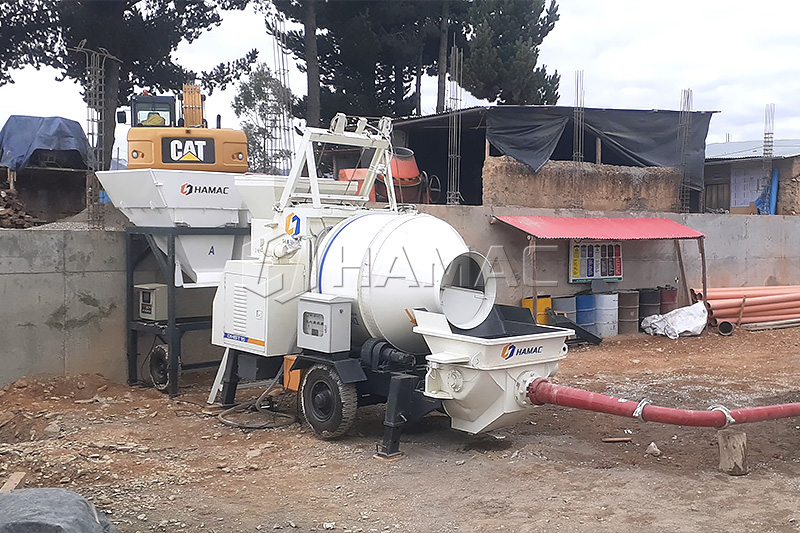
DHBT15 concrete mixer pump for small building maintenance
1. Rural housing and township projects
One of the most typical applications of the DHBT15 concrete mixer pump is rural housing construction and township projects. In villages and small towns, electricity is often unstable, the roads are narrow, and it is not convenient to install a large concrete batching plant or use a big truck mounted pump. The portable DHBT15 can be towed by a small truck to the village, produce concrete using local sand, gravel and cement, and pump it to foundations, columns, beams and slabs of houses and small public buildings. For contractors who build many small houses in different locations, this machine helps them move quickly from one project to another while keeping investment and labour cost under control.
2. Small commercial buildings and workshops
The DHBT15 is also suitable for small commercial buildings, workshops, warehouses and farm buildings where the concrete volume is moderate and the structure height is limited. Typical examples include one‑ to three‑storey offices, storage sheds, agricultural sheds and small industrial workshops. On these projects, the DHBT15 can be placed at ground level, and pipelines can be arranged to deliver concrete to columns, ring beams and floor slabs without using a tower crane or large pump truck. The integrated design means the same machine mixes the concrete and pumps it, which simplifies logistics on the jobsite and reduces the number of operators needed.
3. Slope protection, retaining walls and small infrastructure
For slope protection, retaining walls, small bridges and culverts, the DHBT15 offers a good balance between pumping capacity and mobility. Many of these projects are located on mountain roads or river banks where access is narrow and power supply is not available. The diesel engine of the DHBT15 allows it to work independently of the grid, and its pumping distance is enough to send concrete from a safe flat area to the structure along pipelines. By mixing and pumping concrete on site, contractors can improve the quality and continuity of pouring compared with hand mixing and wheelbarrow transportation.
4. Tunnels, underpasses and interior pours
The DHBT15 concrete mixer pump is also used on tunnels and underpasses for pouring concrete lining, invert slabs and small structural elements inside confined spaces. In these environments, there is limited headroom and truck mounted pumps cannot enter, so a small mixer pump outside the tunnel portal can mix concrete and pump it through pipes to the pouring front. For interior pours in existing buildings or basements, the DHBT15 can stay outside the structure while pipelines and hoses bring the concrete to the required location, which reduces noise and exhaust emissions inside the building.
5. Repair and maintenance projects
Another important group of applications is repair and maintenance projects, such as strengthening old foundations, adding concrete columns, enlarging beams, recasting damaged slabs and repairing small bridges. These projects usually require small but frequent batches of concrete with good quality, and are often located in areas with difficult access for ready mix trucks. The DHBT15 can produce the required amount of concrete on site and pump it precisely into formwork or confined areas, which helps contractors control waste and improve the quality of repair works.
6. When is DHBT15 not recommended?
The DHBT15 is not designed for very large volume projects such as high‑rise buildings, massive foundations or continuous large concrete pours where big stationary or truck mounted pumps and full batching plants are more efficient. If the required concrete output is consistently above 30–40 m³/h for long periods, or if the aggregates are larger than 40 mm, a larger pump or a different mixing solution should be considered. In these cases, the DHBT15 can still be used as a backup machine or for smaller auxiliary structures on the same project, but it should not be treated as the main pump for heavy duty high‑rise construction.
7. How to decide if DHBT15 fits your job?
To decide whether the DHBT15 concrete mixer pump is suitable for your project, you can consider several key points: the total concrete volume per day, the maximum pumping distance and height, the aggregate size, the site access conditions and whether electricity is available. If your jobs are mainly small and medium projects with scattered locations, limited access, and concrete volumes up to about 20–25 m³ per day, the DHBT15 is often a very good choice. For many contractors in rural areas or developing regions, this model becomes a versatile core machine that covers most daily concrete mixing and pumping tasks.
Need help applying this to your project?
Send your material type, target output and site conditions to HAMAC engineers. You will receive a practical equipment configuration and a clear quotation, normally within one working day.
Questions about this topic
How do I choose batching plant capacity?
Estimate the concrete volume per day, then divide by the effective working hours. Add 20 to 30 percent headroom for peak demand. A 35 m³/h plant suits small contractors; 50 to 75 m³/h suits commercial supply; 90 m³/h and above suits large projects.
Which mixer type should I choose for my concrete?
Twin-shaft compulsory mixers are the default for commercial concrete because of short mixing cycles and uniform output. Planetary mixers suit high-grade or special mixes, and drum mixers suit smaller, simpler operations.
How often should wear parts be replaced?
Mixer blades and liners are inspected weekly and normally replaced every 6 to 12 months depending on abrasive content. Belt scrapers, screen meshes and pump wear plates follow the same inspection rhythm.
Can the plant be upgraded later?
Yes. Modular batching plants allow additional silos, a larger mixer or an upgraded control system to be added later without replacing the whole structure.
Keep reading
All news
Related articles
 Exhibitions
HAMAC Highlights Concrete and Aggregate Equipment Solutions for Construction Projects
HAMAC Highlights Concrete and Aggregate Equipment Solutions for Construction Projects Equipment portfolio covers concrete production, mixing
Read more Trade News
HAMAC Trailer Concrete Mixer Pump for Foundation Construction in Peru
Explore how a HAMAC trailer concrete mixer pump supports foundation construction in Peru. See how integrated concrete mixing, pumping and pip
Read more Company News
HAMAC Showcases Group Strength and Concrete Solutions at EXCON 2026
HAMAC showcases its concrete equipment solutions at EXCON 2026 in Peru, with Group leadership, Manager Teo and Peru branch head Carol highlig
Read more