Buyers often compare a concrete batching plant on price before they compare it on duty. The sections below set out what the duty actually involves for a building contractor at altitude working with river gravel, and where cost is really created. The reference case is a 60 m3/h operation in Peru.
The operating context matters as much as the machine specification. In Peru, a building contractor at altitude works in high altitude with strong sunlight and cool nights. A plant specified for this market normally includes altitude-adjusted motor ratings and a control cabin insulated against temperature swings, and the layout is planned around river gravel rather than a generic aggregate.
Cement and fly ash silo sizing
Silo capacity is a function of delivery rhythm, not of plant output. A 100 tonne silo gives roughly one day of production for a 60 m3/h plant using 300 kg of cement per cubic metre. If the nearest cement supplier is two hours away, two silos or a larger single silo avoids stoppages caused by late deliveries.
When the mix design includes fly ash or slag, each binder needs its own silo and screw conveyor. Sharing a silo between two binders is not practical because residual material contaminates the next batch. Silo accessories such as pressure relief valves, level indicators and aeration pads are not optional extras; they are what keeps discharge consistent.
Weighing accuracy and batching tolerance
Commercial concrete is normally batched to within plus or minus one percent for cement and water and plus or minus two percent for aggregates. Achieving that tolerance depends on load cell quality, the rigidity of the weighing frame and the way the discharge gates close. A gate that closes slowly delivers an extra few kilograms on every batch.
Calibration should be carried out with test weights, not by entering an assumed value in the control system. Repeat the check after the first week of production, because settlement of the frame and vibration during operation can shift the zero point. Records of calibration are also part of most quality audits.
Rated output
Typical realistic output
Usual application
HZS25 - 35 m3/h
20 - 28 m3/h
Small contractor, single site
HZS50 - 60 m3/h
40 - 50 m3/h
Commercial supply, small town
HZS75 - 90 m3/h
60 - 75 m3/h
Ready-mix supplier, mid-size city
HZS120 - 180 m3/h
95 - 145 m3/h
High-volume ready-mix, major projects
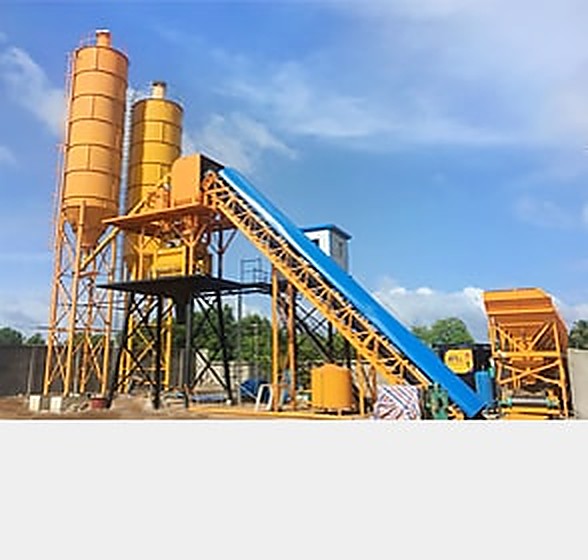
Stationary concrete batching plant with aggregate bins and cement silos — HAMAC equipment supplied to concrete and aggregate projects worldwide.
Mixer selection inside the plant
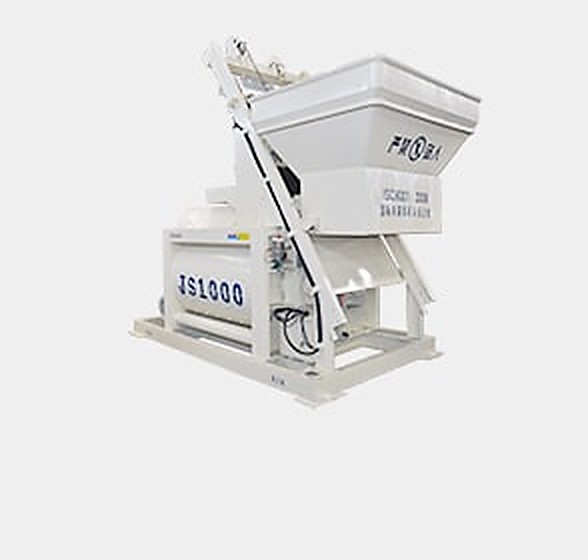
The twin-shaft compulsory mixer is the standard for commercial concrete because it completes a homogeneous mix in 30 to 45 seconds and handles low-slump and high-strength mixes without dead zones. Planetary mixers are chosen for precast, ultra-high-performance concrete and mixes with very fine additions, where the counter-current motion produces a faster and more uniform dispersion.
Mixer size must match the batching machine. A plant with a 2.0 m3 output mixer cannot sustain the rated output of a batching machine sized for 3.0 m3 batches. When output is the priority, it is cheaper to increase mixer volume than to shorten mixing time below the value required for uniformity.
Control system levels and what they change
A manual control system with push buttons and a weighing display is adequate for a single plant with a fixed mix design. A semi-automatic system stores recipes and controls the batching sequence, leaving the operator to manage discharge. Full automation adds production reporting, truck allocation, moisture compensation and remote diagnostics.
The value of automation is not only labour saving. Recorded batch data makes it possible to trace a delivery back to its constituent materials, which is what quality schemes and large project specifications usually require. It also reduces the human error that causes rejected loads.
Mobile concrete batching plant mounted on a steel frame — HAMAC equipment supplied to concrete and aggregate projects worldwide.
Dust, noise and environmental control
Dust comes from three points: aggregate charging, cement filling and truck loading. Enclosing the batching machine and fitting a shaker or pulse-jet filter to the silo handles most of it. Water sprays at the charging hopper are effective but must not add uncontrolled water to the mix, so they are usually interlocked with the batching sequence.
Noise is dominated by the mixer, the air compressor and the aggregate feed. Rubber buffers under the mixer frame, a silenced compressor and a lined control cabin bring the working environment within normal industrial limits. Settlement ponds or a recycling unit deal with wash water from the mixer and truck chute.
Commissioning sequence
Commissioning begins with a mechanical check of every bolt, guard and limit switch, followed by a dry run of each motor in the correct direction. Weighing systems are then calibrated empty and with test weights before any material enters the plant.
The first production batches should be small and inspected for uniformity and slump. Only after three consecutive batches meet the specification should the plant move to normal output. Recording the actual cycle time during these first batches gives a realistic figure for planning deliveries.
Maintenance rhythm that prevents stoppages
Daily checks cover the mixer blades and liners, the discharge gates, the air line pressure and the water supply. Weekly checks include belt tension, screw conveyor bearings and the condition of the weighing frame. Monthly work covers gearbox oil, filter cleaning and a full calibration verification.
Wear parts should be replaced on measurement, not on failure. Mixer blades worn beyond the manufacturer limit lengthen mixing time and leave material on the floor of the drum, which shows up as variation between batches long before a breakdown occurs.
Where to go next
For the equipment side, see concrete batching plants; for plant-level design and layout questions, see concrete production solutions. If the project is in Peru or a comparable market, the HAMAC team can provide reference installations and a configuration proposal against your daily output target.
Send the daily volume, mix types and site conditions to HAMAC engineers and you will receive a configuration and a quotation, normally within one working day.
Need help applying this to your project?
Send your material type, target output and site conditions to HAMAC engineers. You will receive a practical equipment configuration and a clear quotation, normally within one working day.
Questions about this topic
What maintenance is required weekly?
Check mixer blade clearance, discharge gate seals, air line pressure, belt tension, screw conveyor bearings and the condition of the weighing frame. Record the results so trends are visible.
What size batching plant do I need for 200 m3 per day?
A 50 to 60 m3/h plant covers 200 m3 in a single extended shift with normal truck turnaround. If the work is concentrated into a short window, choose 75 to 90 m3/h so the plant is not the constraint.
Is a foundation required for a batching plant?
Yes for stationary plants. The foundation drawings are issued with the order and must be followed, because the batching machine, silo and mixer loads are concentrated. Mobile plants sit on compacted hardstanding.
H
HAMAC Machinery Editorial Team
Written and reviewed by engineers and sales specialists who configure concrete batching plants, crushers, mixers and pumps for projects in more than 180 countries. Content is based on factory testing data and field feedback from delivered equipment.






 Company News