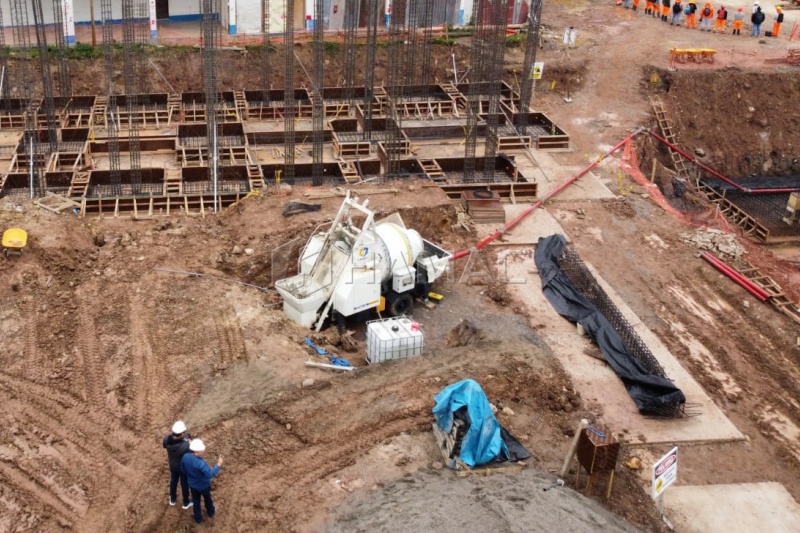
Many people know that "maintenance instead of repair" is always promoted by the machinery industry, about the loader, the daily inspection and maintenance is particularly important, basically every day in use, in order to produce the safety and efficiency of the guarantee, please be sure to learn the maintenance knowledge.
Just stop working, the engine coolant, oil in all parts, exhaust pipe and muffler are in high temperature, if remove the cover or drain the oil or replace the oil filter, etc. will cause scalding or other injuries, should wait for the temperature to drop down before maintenance and check.
Check whether the connecting bolts of front and rear drive shaft are loose or fallen off, and the locking force is 530N.M.
Check whether the working lights, indicators, etc. are broken, and whether the lines and pipes of electricity, gas and oil are aged or broken.
Check the dust of the engine air filter, whether it affects the air intake effect.
Check whether the pin and other connecting bolts are loose.
Check whether the tires are broken and whether the inflation is satisfied (front wheels: 0.30-0.32 MPa, rear wheels: 0.28-0.30 MPa). It is necessary to control the tire air pressure within the specified range. Check whether the tire bolts are loose and the locking force is 830 N.M.
Check whether there are oil, water, electricity and air leaks.
Check the water level, gearbox oil level, hydraulic oil level, brake oil level.
Grease each oil nozzle.
Check the brake pad wear condition
Check the wear condition of the bucket blade and bucket teeth. When the blade wears 10cm and the bucket teeth wears more than 1/4 of the full length, repair or replace them.
When removing or dismantling the battery, the positive and negative poles should be distinguished and the nut should be tightened securely.
Prevent metal objects (such as: things, etc.) from accidentally touching the battery terminals and causing a short circuit.
The battery electrolyte contains sulfuric acid, and can generate hydrogen gas, to prevent cigarettes and open fire near the battery. If the sulfuric acid liquid spilled into the skin, eyes should be immediately flushed with a lot of water, and in severe cases should immediately go to the hospital for treatment.
Need help applying this to your project?
Send your material type, target output and site conditions to HAMAC engineers. You will receive a practical equipment configuration and a clear quotation, normally within one working day.
Questions about this topic
How do I choose batching plant capacity?
Estimate the concrete volume per day, then divide by the effective working hours. Add 20 to 30 percent headroom for peak demand. A 35 m³/h plant suits small contractors; 50 to 75 m³/h suits commercial supply; 90 m³/h and above suits large projects.
Which mixer type should I choose for my concrete?
Twin-shaft compulsory mixers are the default for commercial concrete because of short mixing cycles and uniform output. Planetary mixers suit high-grade or special mixes, and drum mixers suit smaller, simpler operations.
How often should wear parts be replaced?
Mixer blades and liners are inspected weekly and normally replaced every 6 to 12 months depending on abrasive content. Belt scrapers, screen meshes and pump wear plates follow the same inspection rhythm.
Can the plant be upgraded later?
Yes. Modular batching plants allow additional silos, a larger mixer or an upgraded control system to be added later without replacing the whole structure.
H
HAMAC Machinery Editorial Team
Written and reviewed by engineers and sales specialists who configure concrete batching plants, crushers, mixers and pumps for projects in more than 180 countries. Content is based on factory testing data and field feedback from delivered equipment.





 Exhibitions